Galaxy XR vs Apple Vision Pro: specs, price and verdict
Samsung attacks at half the price with Gemini; Apple answers with M5 and ecosystem depth. A full comparison — and which headset makes business sense.
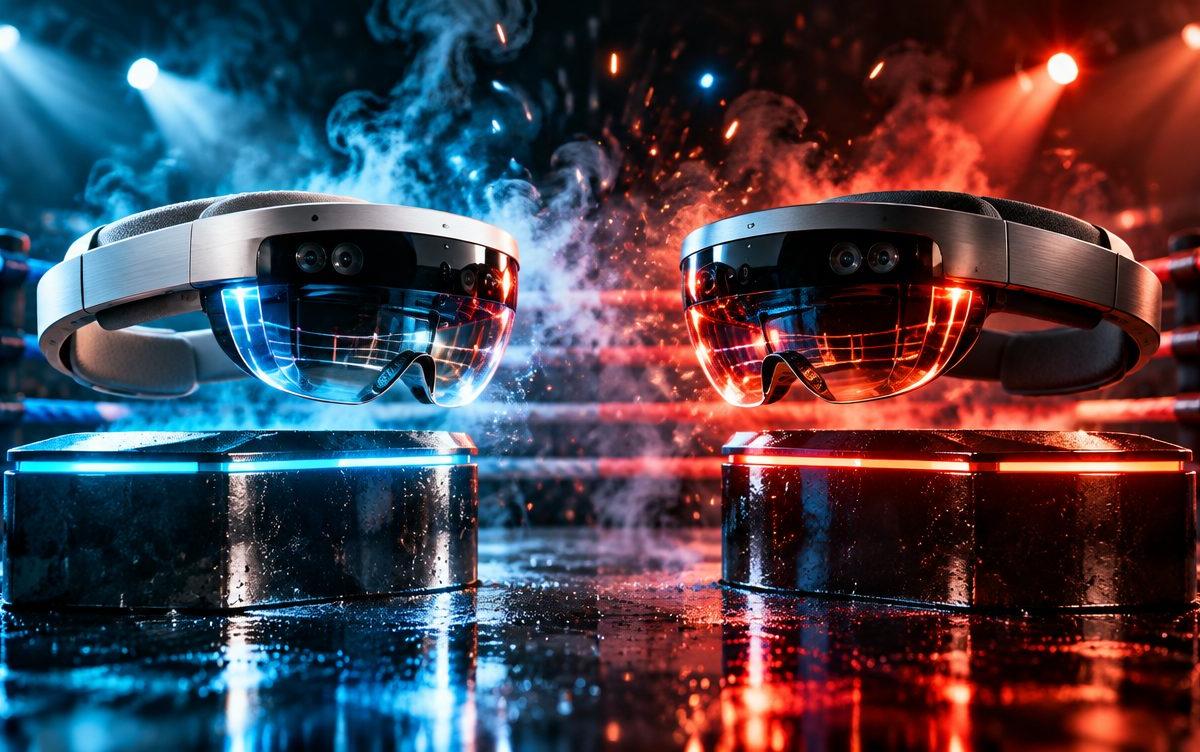
Galaxy XR vs Vision Pro at a glance
| Samsung Galaxy XR | Apple Vision Pro (M5) | |
|---|---|---|
| Launch price (US) | $1,799 | $3,499 |
| Chip | Qualcomm Snapdragon XR2+ Gen 2 | Apple M5 |
| Geekbench multicore (approx.) | ~2,450 | ~17,800 |
| Displays | Micro-OLED, 4K-class, HDR | Micro-OLED, 4K-class, HDR, up to 120 Hz |
| Weight | ~545 g | ~600–650 g |
| Battery (general use) | ~2 h | up to 2.5 h |
| Operating system | Android XR (Google Play apps) | visionOS (App Store apps) |
| Voice assistant | Gemini, built in | Siri |
| Enterprise app deployment | Custom apps without a single store gate | Through Apple's app distribution |
Figures as published by Samsung and Apple at launch; Geekbench scores are approximate public results.
For ten years we waited for someone to step into the ring against Apple in the heavyweight division — and in October 2025, Samsung finally climbed through the ropes. Galaxy XR (long known as Project Moohan) is the first Android XR headset, born from the Samsung + Google + Qualcomm alliance, and it attacks Vision Pro exactly where it hurts most: at half the price.
$1,799 versus $3,499. That's not just aggressive positioning — it's an open invitation to everyone priced out of spatial computing so far. But does cheaper mean better? Let's break the fight down. 🥊
Round 1: Displays — a surprising draw
Both devices run micro-OLED panels with 4K-class resolution and HDR — a category above the LCDs in Quest 3. The picture-quality gap that dominated every 2024 comparison has essentially evaporated: Samsung even chases higher pixel density, while Apple keeps the refresh-rate edge (up to 120Hz after the M5 update).
For visual quality, you're no longer choosing between "good and better" — you're choosing between two benchmarks.
Round 2: Raw power — a knockout for Apple
Here the match is one-sided. Apple's M5 chip posts a CPU more than 7x faster than the Snapdragon XR2+ Gen 2 inside Galaxy XR (roughly 17,800 vs 2,450 in Geekbench multicore). That's the difference between desktop-class performance and something below flagship-smartphone power.
The uncomfortable question for Apple, though: the visionOS ecosystem still isn't using that hardware headroom. Power without apps to consume it is a spec-sheet victory.
Round 3: AI and ecosystem — Samsung counters
Galaxy XR's strongest argument isn't the price — it's Gemini. The AI assistant is built deep into the device: it sees what you're looking at through the cameras, responds contextually to voice, gaze and gestures, and Circle to Search works directly in passthrough. Look at an object → gesture → answer. This is the first headset designed around AI rather than with AI bolted on.
Apple answers with ecosystem depth: over 1 million compatible apps (though native spatial apps number in the hundreds), Mac Virtual Display for work, and the exclusive Apple Immersive Video format — 8K 3D content with no equivalent elsewhere. If you live in the Apple world, Vision Pro slots in seamlessly.
Samsung counters with the Play Store's thousands of 2D Android apps — and one detail that outweighs every spec for business buyers: enterprises can deploy custom XR apps without waiting for a single app store's approval. Anyone who has sat through a review process for an internal training app knows why that matters.
Round 4: Comfort and endurance
Galaxy XR weighs about 545 grams against Vision Pro's 600–650 — a tangible difference in long sessions, even after Apple's improved head strap. Samsung's Achilles heel: roughly 2 hours of battery. Annoying at home; manageable in business scenarios with device rotation.
The verdict
- Vision Pro remains the technology benchmark — for creative professionals, Mac-centric workflows, and scenarios where maximum power and picture justify $3,499. But remember: Apple has paused headset hardware and is looking toward glasses.
- Galaxy XR is the pragmatic premium pick — 90% of the experience at half the price, with the best AI integration on the market and a more flexible path for enterprise deployment.
- And the $500 Quest 3 quietly reminds everyone that for scaled business scenarios — training dozens of employees, event activations — one Vision Pro costs as much as an entire fleet of Quests.
What this means for your project
Choosing the headset is the last decision, not the first. The right order is: goal → content → platform. For VR training across 50 employees, a premium headset is luxury without ROI; for an executive showroom or top-tier product visualization, it's exactly the right tool. And when you need the experience to reach everyone — no headset at all — WebXR solves the equation in the browser.
The giants are fighting for your head. We make sure your business wins from the fight, whoever leads on points. ⚔️
Next in Meta Wars: Meta killed the metaverse (to save the glasses) — the biggest strategic reversal of the entire war.
Part of the Meta Wars series — chronicling the war for the next computing platform.
Frequently asked questions
Is Galaxy XR better than Vision Pro?
Not across the board. Vision Pro M5 is faster and has the more mature ecosystem; Galaxy XR costs about half as much ($1,799 vs $3,499), is lighter (~545 g vs ~600–650 g), has Gemini built in and lets enterprises deploy custom apps more freely. For most business pilots Galaxy XR is the pragmatic pick; for Mac-centric creative work Vision Pro still leads.
How much more powerful is Vision Pro M5 than Galaxy XR?
In Geekbench multicore the M5 scores roughly 17,800 against roughly 2,450 for Galaxy XR's Snapdragon XR2+ Gen 2 — more than 7× faster on CPU. The catch is that few visionOS apps use that headroom yet.
Android XR vs visionOS: which has more apps?
Apple counts over 1 million compatible apps on Vision Pro, but native spatial apps number in the hundreds. Android XR runs thousands of 2D Android apps from Google Play. For business, the bigger difference is deployment: Android XR lets you install internal apps without waiting for a single store review.
Which headset should a company buy for VR training?
Usually neither for scale. One Vision Pro costs as much as a fleet of Quest 3 headsets, so training dozens of employees is cheaper on Quest — or on no headset at all with WebXR in the browser. Premium headsets make sense for executive showrooms and high-end product visualisation.